
FSS EVENTS | STAFF | FAQ | LEAGUE | SHOP
Every few years, a version of this conversation resurfaces.
Rumors are circulating — again — that Major League Baseball may be exploring structural changes to the draft that could significantly reduce, or even eliminate, the selection of high school players. As of now, that’s exactly what it is: rumor. No formal proposal. No approved framework. No negotiated agreement.
But rumors don’t exist in a vacuum, and this one deserves real context, especially from people who operate inside the amateur baseball ecosystem every day.
At Future Stars Series, we don’t just evaluate players. We evaluate value. We forecast roles. We study tools, skills, instincts, risk-reward profiles, growth templates, biomechanics, data modeling, measurables, and long-term impact. Our lens is not speculative, it’s predictive.
We develop players, and well.
After a decade in this space — and a lifetime in the game as a player and a scout, working at multiple levels, working for clubs, and covering everything from international baseball through Major League organizations and their systems — I’m comfortable saying our lens, our position, and our ability to speak on this topic from a true seat at the table is clear.
At Future Stars Series, this isn’t theory or commentary written from behind a desk. We are actively involved. We work directly with players, families, agents, trainers, schools, and organizations at every level. We are in the middle of the process — development, evaluation, decision-making, and value alignment—and that provides perspective across high school, junior college, NCAA, international baseball, and Major League Baseball itself.
Instead of speaking about players, we are engaged with them. That matters.
In 10 years, with roughly $500 million in draft and signing value moving through our platform across high school, junior college, college, and international pathways, we’re comfortable saying this: high school players are not becoming less relevant. If anything, the current structure of the game may be quietly strengthening their position.
A Seat at the Table — Not the Sidelines
This perspective isn’t theoretical.
I’ve been in rooms where the future of the sport has been discussed. I’ve heard Commissioner Rob Manfred speak directly about his long-term goal of a unified employment system for everyone entering professional baseball. He’s said it publicly. He’s said it privately. I heard it myself.
On the surface, the idea makes sense. In practice, baseball is not a nine-to-five global industry. It’s a sport operating across different labor laws, education systems, cultural norms, professional leagues, and economic realities worldwide. That complexity is exactly why these changes — if they ever happen — face enormous hurdles.
The NCAA: The Biggest Domestic Roadblock
If high school players were to be phased out of the draft, the NCAA would have to absorb them. Historically, that hasn’t worked cleanly.
Years ago, MLB attempted to expand and lengthen scholarship structures to better support college players. Those efforts went nowhere. Fast-forward to today, and the NCAA landscape looks completely different: unlimited scholarships, NIL collectives with massive funding, transfer portal dominance, and win-now pressure overtaking long-term development.
College baseball still develops players — but it is structurally incentivized to win immediately.
An Aging and Higher-Pressure College Game, and Why That Matters
As eligibility rules evolve, college baseball is getting older. Junior College eligibility is being actively challenged. The NJCAA is not governed by the NCAA. Real legal arguments now exist questioning whether JUCO time should count against NCAA eligibility at all, and we’re already seeing precedent in other sports.
If those walls continue to crack, expect more 23-, 24-, and 25-year-old players on college rosters, more graduate transfers occupying key roles, and younger players blocked by older, paid, portal-acquired talent.
That environment does not favor the traditional high school-to-college-to-pro pipeline. Ironically, it creates faster professional pathways outside the NCAA.

The “Extra Year of Data” Argument — and Why It’s Already Being Solved
One of the central reasons people discuss eliminating high school players from the draft is the belief that doing so would provide an additional year of data capture and college certainty. On its face, that sounds reasonable. In reality, the industry is already addressing this.
Several organizations and operators working directly with high school players—including those deeply involved in evaluation, development, and data modeling—are actively finding ways to keep elite players competing against quality competition while continuing to generate meaningful data.
That requires a pivot. It requires a mental pivot by the player and the family, one that prioritizes long-term goals like professional baseball or high-level college placement as viable employment and business opportunities, rather than chasing volume for volume’s sake.
That means moving away from the idea that development comes from playing in massive tournaments on Field 79 against inferior competition, simply because someone might be watching.
Now, that statement will upset some people. Entire businesses have been built around that model—and to be clear, those businesses helped create and shape the modern amateur baseball industry. That matters, and it deserves respect.
But from a developmental standpoint, traveling endlessly to play in every possible event, in every possible city, against uneven talent does players no favors.
The game has changed.
Evaluation is now centralized around:
• Data systems
• Quality of gameplay
• Competitive environments
• Repeated exposure against legitimate peers
• Video systems that make in-person attendance less important
There are team-based solutions for this. There are individual player solutions for this. And they are already being implemented. As long as that trend continues — and it is — high school players increase their value. They don’t lose it.
Why High School and Junior College Matter
High school and junior college players retain flexibility that NCAA players increasingly do not. Immediate draft eligibility. Junior college as a low-restriction alternative. No NCAA age caps. The ability to sign after every JUCO season.
As the NCAA becomes older and more transactional, these pathways remain efficient, adaptable, and draft-relevant. High school players aren’t being eliminated. They’re being repositioned.
The International Reality: Why a Unified System Breaks Down
Internationally, the draft conversation has existed for years. In theory, an international draft, particularly in Latin America, could make sense. In reality, it’s extraordinarily complex. Within international structures, you’re dealing with different educational norms. Every country does things differently. While Major League Baseball is a global game, it operates through layers of levels and sublevels, each with its own hurdles.
In Latin America, it’s widely acknowledged that many players stop attending school early or receive very limited formal education. That has to change, but any international draft would require players to be older, which immediately alters the system.
Complicating matters further: the vast majority of international signees come from the Dominican Republic. That does not automatically open access for other countries. You’re dealing with posting fees, domestic leagues doing significant business with their own citizens, and revenue models that would need to be sacrificed to implement a draft.
In many ways, an international draft represents the end of a free market—something the Players Association has never favored. While salary guidelines already exist, the trend is clearly toward some form of cap, though what that looks like remains unknown.
Have there been conversations? Yes. Have there been inroads? Absolutely. But a true international draft under one unified system is still a long way off.
Major League Baseball cannot — and will not — cut itself off from Latin, Asian, Caribbean, or European talent. And if a unified labor system requires an international draft to function, then the logic for eliminating high school drafting collapses with it.
Development Still Matters
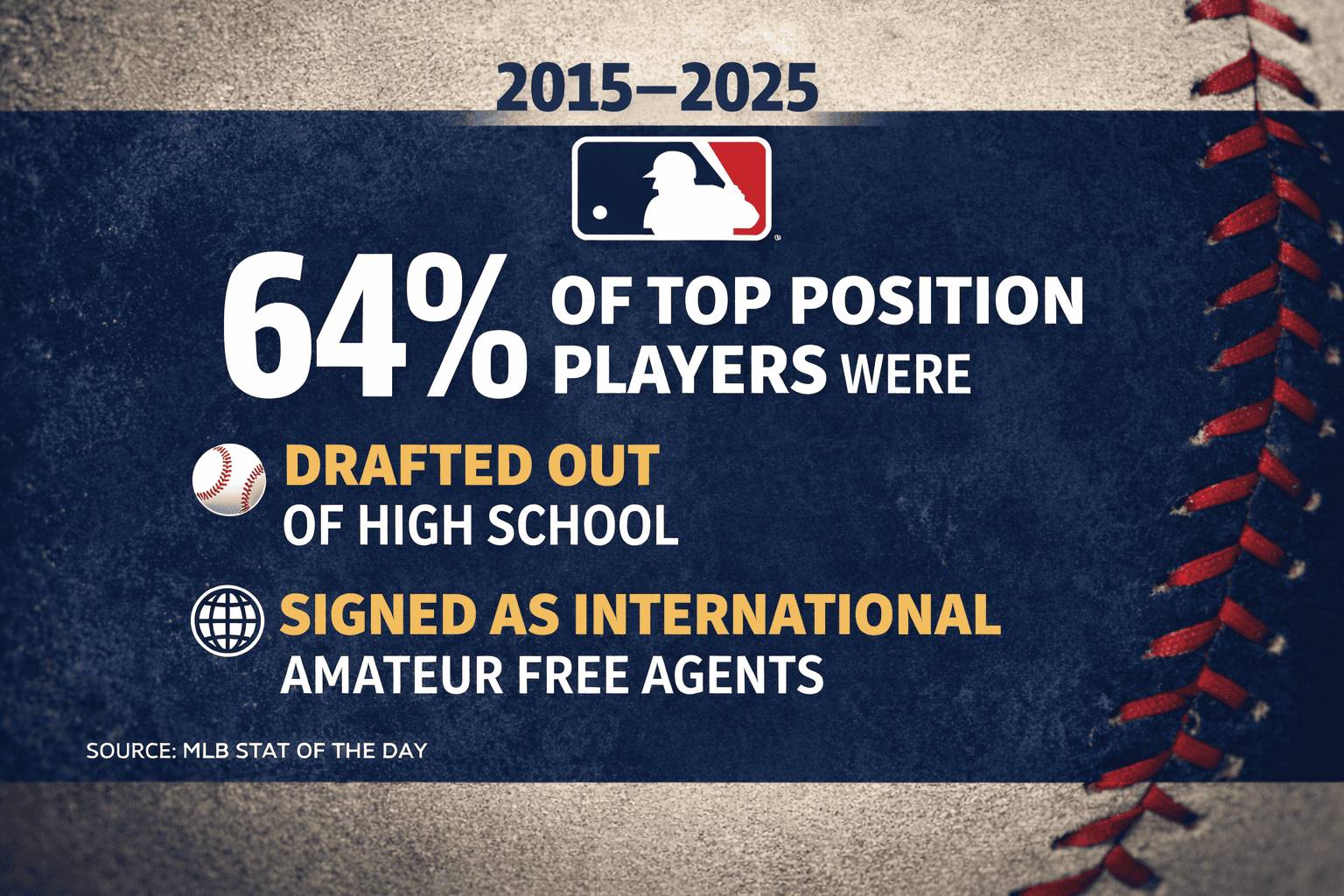
One reason these rumors persist is that MLB has openly discussed contracting the minor leagues again, potentially by another affiliate. Most people understand that high school players need more time to develop. That’s simply age and physiology. But if you reduce affiliates to eliminate high school development time, you also eliminate development time for international players, who sign even younger. That doesn’t just cut costs. It cuts late bloomers.
Across baseball history, more players who were not elite at 14 or 15 eventually make it than those who were hyped early and stayed on that trajectory. Development is not linear. Shortening development windows increases acquisition costs, raises failure rates, and reduces long-term return on investment. The most economical way to acquire players remains the draft and international free agency. That hasn’t changed.
The Final Point
The high school player sits in a rare position: fewer restrictions, more optionality, earlier entry, and a longer development runway. Taking those options away makes little sense, not for MLB, for players, or for the sport itself.
Are there pressures on the system? Yes. Are there conversations happening? Absolutely. Is anything possible? In theory, sure.
But given the economics, development realities, international complications, and the direction of the game itself, it’s very hard to see high school players being eliminated from the draft.
Rumors may abound, but reality tells a different story.
- BOOTH: 8 premier 2027 standouts at East Coast Pro - August 6, 2026
- BOOTH: The Road to the 2027 Draft - July 19, 2026
- BOOTH: MLB Draft Continues to Evolve - July 12, 2026